Every city has its own relationship with fitness. That relationship is shaped by culture, climate, work patterns, food habits and the values that quietly govern how people spend their time and money. Singapore’s version is distinctive — and understanding it matters if you want to train in a way that actually fits your life here.
The performance city dynamic
Singapore is a city of high achievers. Academic performance, career advancement, financial success; these values run deep. That achievement orientation extends into fitness: pressure to look a certain way, perform at a high level, post the workout, complete the marathon.
For some people, this cultural pressure is useful fuel. For many others, it creates a specific kind of paralysis. Starting feels exposing. Being seen as a beginner in a city that rewards competence is uncomfortable. The gym floor can feel like one more arena for comparison.
This is one of the reasons private training resonates strongly with a certain kind of Singapore professional. The private studio environment removes the social performance dimension entirely. You’re training for yourself, in a space designed for that purpose, without an audience.
The food culture reality
Singapore has one of the world’s great food cultures. Hawker centres, kopitiam breakfasts, mamak stalls, weekend dim sum, client dinners at restaurants where declining the ordering would be socially costly. Eating here is communal, celebratory and deeply embedded in relationships and identity.
Most generic nutrition advice fails in this context because it assumes you cook your own food and eat on a schedule. The Singapore reality is different. Meals are often chosen from menus, not made at home. Social eating is constant. The food itself — even the hawker staples — is genuinely delicious and restriction-based approaches are hard to sustain when your entire social life involves food.
Effective nutritional coaching in Singapore works with this reality, not against it. It teaches you how to make better choices at the hawker centre, how to navigate a business dinner without abandoning your goals or being socially difficult and how to manage the drink culture at client events.
The climate factor
Thirty degrees and 80% humidity, year-round. For outdoor training: running, cycling, court sports — this is a significant variable. Heat acclimatisation is real and takes weeks. Exercise-induced heat stress is a genuine risk for newcomers and for locals who’ve spent extended periods in air-conditioned offices.
Singapore’s fitness culture has adapted. Morning training (before 8am) and evening training (after 7pm) are the dominant outdoor windows. Indoor training is the default for most serious strength and conditioning work. This isn’t a limitation — it’s pragmatism. The most sustainable approach to fitness in Singapore accounts for the climate rather than fighting it.
The time scarcity problem
Singapore works hard. Long hours are a norm across industries and the culture of visible commitment: staying late, responding late, being perpetually available — creates a specific kind of time poverty that isn’t just logistical. It’s psychological.
For fitness to work in this environment, it has to be efficient, scheduled and low-friction. The model that tends to succeed: a fixed weekly appointment treated as non-negotiable, a private studio that eliminates commute-and-wait friction and a coach who prepares the session in advance so there are no decisions to make when you arrive. The model that tends to fail: open-ended gym memberships, self-directed training that relies on motivation at the end of a ten-hour day, group class schedules that don’t accommodate senior professional unpredictability.
The longevity shift
Something is changing in how Singapore’s successful professionals think about fitness. The earlier generation often treated health reactively — when a doctor flagged a problem, when a health scare hit. The current generation is increasingly thinking about it proactively.
The conversation around healthspan — not just how long you live, but how well you live across your 60s, 70s, and beyond — is gaining real traction. Strength training, mobility work, sustainable nutrition and stress regulation are being discussed not as fitness goals but as longevity investments. This shift is particularly visible in Singapore’s 40-and-above professional demographic.
It’s a cultural moment that aligns with what MOVE has always believed: that training isn’t primarily about how you look in the short term. It’s about how you move, feel and function across the full arc of your life.
What this means practically
Choose a format that fits your real schedule, not your ideal one.
- Two consistent sessions per week beats four sessions that happen for six weeks and then stop.
- Find a coach who understands Singapore’s food culture and can work with it, not prescribe around it.
- Train indoors for the majority of your structured work. Use the outdoors strategically, in the right windows.
- Invest in the relationship before the method. The best programme in the world produces no results without the accountability to show up.
Think long. The most important fitness decisions you make in your 40s are the ones that protect your quality of life in your 60s and 70s.
MOVE in Singapore
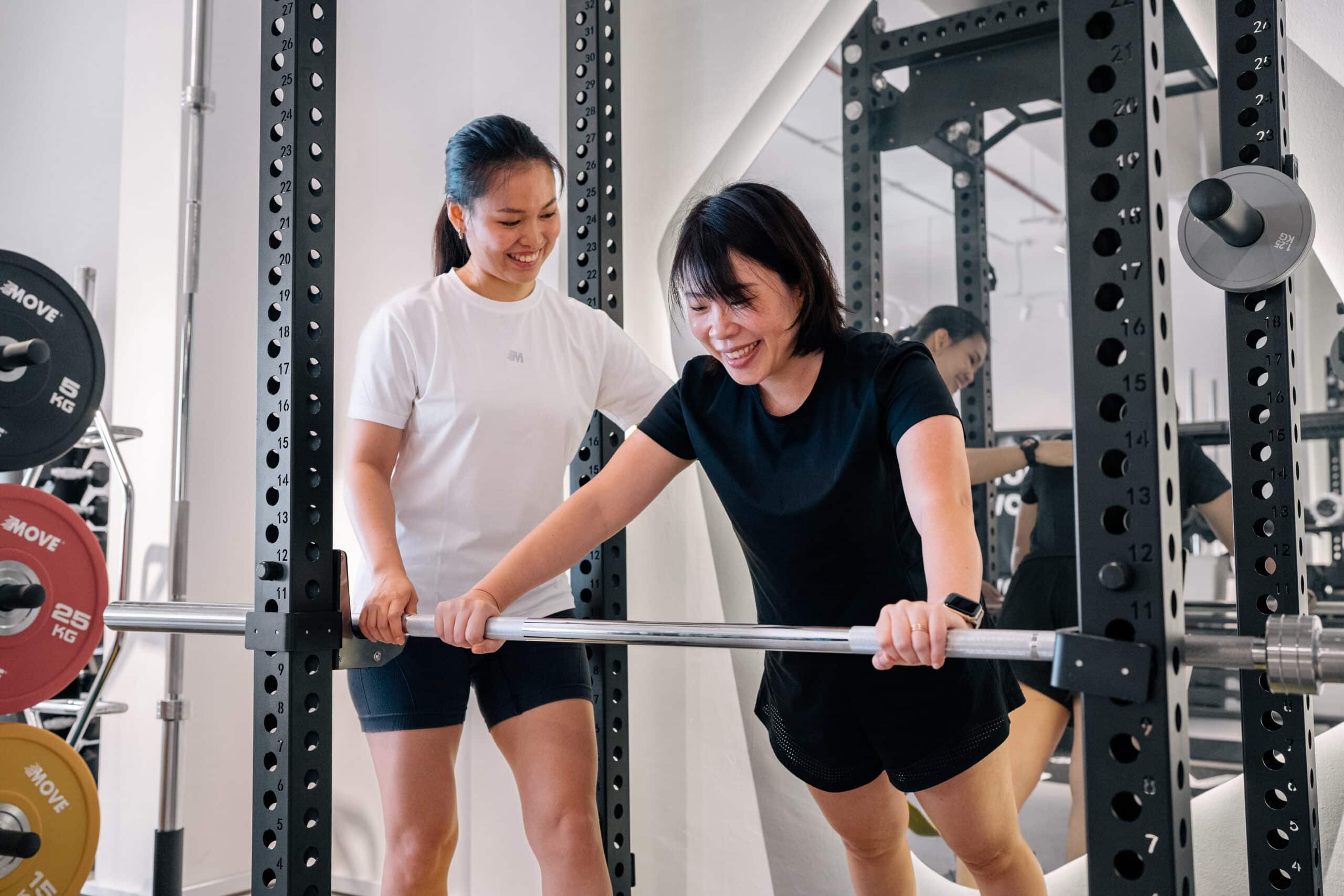
MOVE Private Fitness is built on these beliefs. Private, appointment-based, holistic — designed for people who want coaching that fits their actual life rather than an idealised version of it. We’re bringing the coaching standard and culture built across Malaysia and Thailand into our Singapore studios. Come in for a free consultation and let’s have an honest conversation about what training that actually fits your life looks like.