It started as tightness across your shoulders that you figured would resolve itself. Then the lower back ache became a constant. Now you plan your workday around how long you can sit without your neck locking up.
You’re not unusual. Singapore has one of the highest concentrations of desk-based professionals in the region — finance, tech, law, consulting, government — and a significant portion of that workforce spends eight to twelve hours a day seated in environments that are ergonomically indifferent at best. The physical cost accumulates slowly, then all at once.
The good news: almost all of it is correctable with the right approach.
What extended sitting actually does to your body
Hip flexors shorten from remaining contracted for hours. Glutes become inhibited — they stop firing properly because they’re rarely asked to work, which is a significant contributor to lower back pain and knee instability. The mid-back loses mobility and rounds forward, pulling the shoulders inward and the head forward. Deep core muscles atrophy from lack of demand.
None of these changes is dramatic on any given day. But over years, they compound into the pattern many desk workers recognise: lower back tightness that doesn’t fully resolve, shoulder aches, neck tension, and a general physical stiffness that wasn’t there a decade ago.
Why the gym alone often doesn’t fix it
Many people with desk-job movement issues do go to the gym. But without targeted corrective programming, gym training can reinforce existing imbalances rather than resolve them.
Bench press with rounded shoulders loads the front of the body while the already-tight chest shortens further. Squats with anterior pelvic tilt and inhibited glutes put excessive load on the lower back. Pulling movements without proper scapular activation don’t engage the muscles that counteract desk posture.
The issue isn’t exercise per se — it’s exercise without an assessment of your movement patterns and a programme designed to address what’s actually limited or imbalanced.
What corrective training looks like in practice
Effective training for the desk-bound workforce starts with a thorough movement assessment. Before any loading, a good coach looks at how you move — your hip mobility, thoracic rotation, shoulder mechanics, your ability to activate your glutes and core. From that baseline, they identify the specific patterns that need addressing.
Typical priorities for Singapore’s office workers: hip flexor lengthening and posterior chain strengthening (glutes, hamstrings, lower back extensors) to correct anterior pelvic tilt and reduce lower back strain; thoracic mobility work to restore mid-back rotation and extension, taking pressure off the neck and shoulders; scapular stability exercises (rows, face pulls, specific shoulder mechanics work) to counter the rounded-shoulder pattern; and deep core activation to restore the stabilising function that extended sitting undermines.
None of this requires special equipment or exotic movements. These patterns can be addressed in two sessions per week with a programme that’s been intelligently designed for your specific compensations.
The pain question
If you have existing back or neck pain, the instinct is often to avoid exercise. For most non-acute musculoskeletal pain — the chronic, low-grade variety that desk workers accumulate — appropriate movement is one of the most effective tools available. The key word is appropriate: graded, progressively loaded, and calibrated to what your body can currently tolerate.
If you have a confirmed disc injury or an acute pain episode, work with a physiotherapist first and transition to a personal trainer once the acute phase has resolved. A good trainer will coordinate with your physio where needed, and the two modalities complement each other effectively.
Consistency over intensity
Posture and movement quality are cumulative. They take months to meaningfully shift — but they do shift with consistent, targeted work. The goal isn’t to out-train eight hours of sitting each day. It’s to counterbalance it progressively, build the strength and mobility that sitting erodes, and give your body the stimulus it needs to adapt. Two sessions per week is sufficient to produce measurable changes in posture, pain levels, and functional movement within three to six months.
What MOVE does for this group
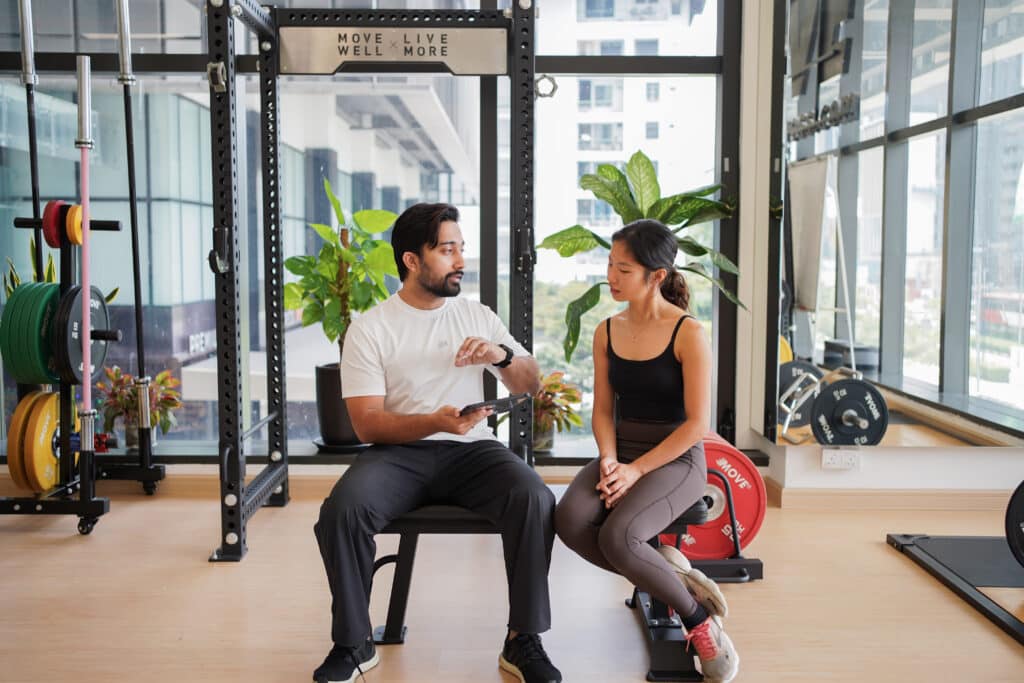
MOVE Private Fitness works with a significant number of Singapore professionals who come in specifically with desk-related movement issues. Every client begins with a thorough movement assessment. Programming is built from what we find — not from a template. Our coaches are trained to identify and address the common patterns that desk work produces, and to progress clients safely toward better movement, reduced pain, and stronger function. Many of our clients describe the experience as realising — sometimes for the first time — that the way their body moves isn’t fixed. It’s trainable. Read their stories here.
If your desk job has left its mark on how you move and feel, come in for a free consultation at MOVE Singapore. We’ll start with an assessment and build from there.