You know the problem. You’ve known it for years. It’s not that you don’t care about your health — it’s that by 8pm you’ve already made two hundred decisions and you have nothing left for one more.
Most fitness advice is written for people with predictable schedules and the luxury of planning their week in advance. This is for people who are genuinely busy: calendar-full, mentally depleted, frequently travelling. The approach that actually works for this group is specific and it’s different from standard guidance.
Why the usual advice doesn’t apply
‘Train four times a week, meal prep on Sundays, get eight hours of sleep.’ Technically sound. Practically useless when your Monday schedule is set Sunday evening. This group needs a different design: fewer sessions, higher leverage and a coach who can work around your actual week — not an idealised version of it.
Two sessions per week is not a compromise
Two quality sessions per week, done consistently, produce significant and measurable fitness improvements over time. That’s achievable even in a packed professional schedule. Three is aspirational. Four is rarely sustainable for this group and usually leads to the familiar pattern: three intense weeks, then nothing for two.
The research on resistance training is clear: frequency matters less than consistency. Showing up twice a week, every week, across twelve months outperforms sporadic high-frequency training by a wide margin. A good coach designs your programme around two high-quality sessions, not four mediocre ones squeezed into an already stretched week.
Training as stress regulation, not another obligation
This is the reframe that changes everything for high-performing professionals: training isn’t supposed to feel like another item on the list. Done well, it’s one of the most effective tools for managing the cognitive and physiological load of a demanding career.
Strength training has strong evidence for reducing cortisol over time, improving sleep quality and increasing what researchers call stress inoculation — the body’s capacity to handle pressure without deteriorating. Executives who train consistently tend to be sharper, more patient and more resilient under pressure. That’s not motivational language. It’s a documented physiological outcome.
But this only works if the training itself doesn’t add to your stress load. That means sessions that fit your schedule reliably, a coach who doesn’t require you to arrive at 100% energy and an environment where you’re not managing anyone else’s timeline or competing for equipment.
What a private studio solves
Commercial gyms introduce friction: commute, queue for equipment, manage your own session, commute back. For busy professionals, that friction is the difference between going and not going.
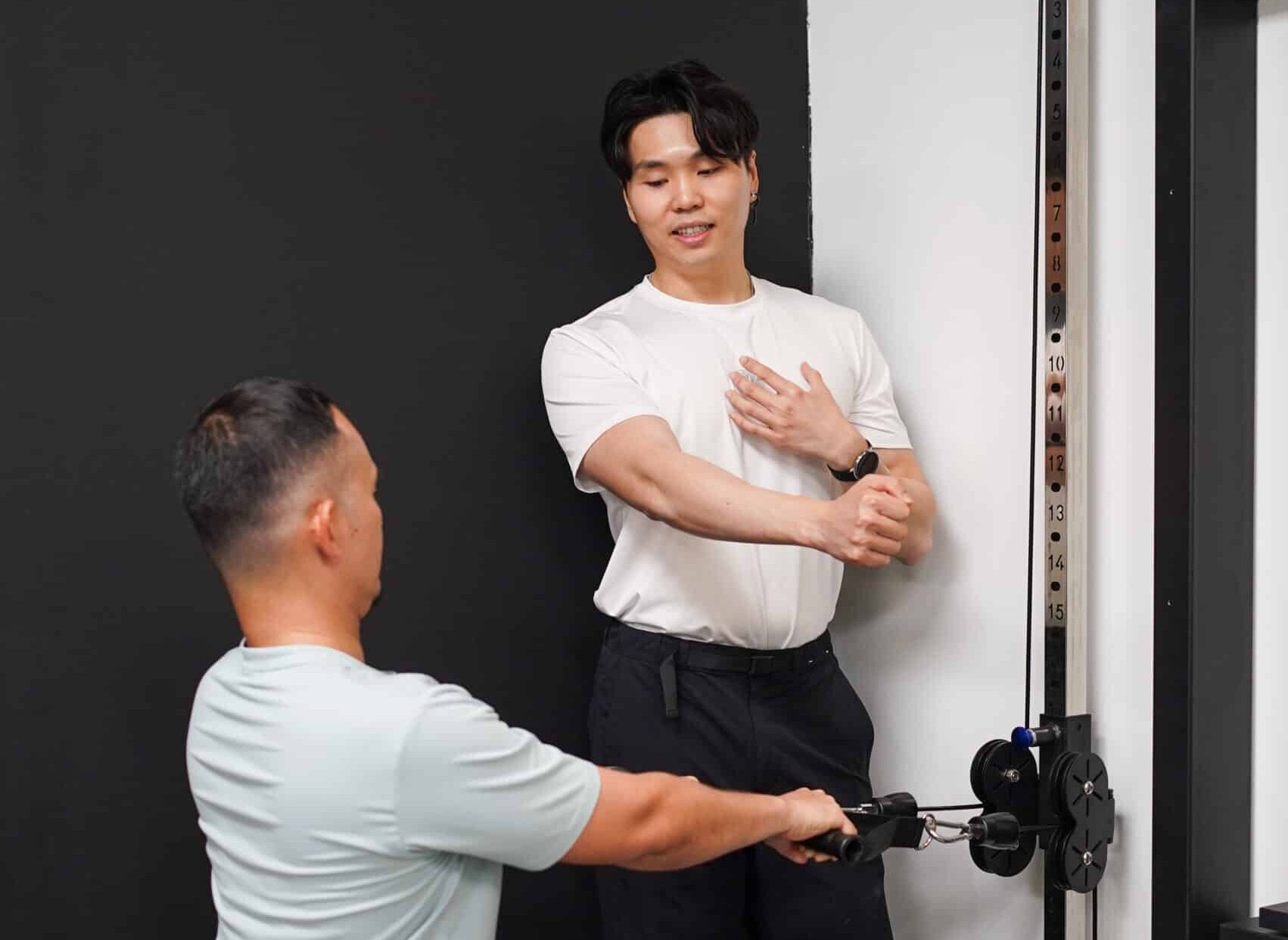
An appointment-based private studio removes most of this. You arrive. Your coach has the session ready. You train. You leave. No decisions to make. No environment to navigate. The whole experience is designed around your time.
Nutrition without the overhaul
Most nutrition advice assumes you cook your own food and eat on a schedule. Singapore’s professional reality looks different: client dinners, hawker lunches eaten quickly, regional travel, early starts that skip breakfast.
Effective nutritional coaching for this group is pragmatic and adaptive. It doesn’t hand you a meal plan you’ll follow for two weeks before the next business trip breaks it. It teaches you how to make better choices in the reality of your schedule — the higher-protein hawker options, the drinks to avoid at client events, the simple habits that don’t require willpower at 9pm after a twelve-hour day.
The travel problem
Many Singapore-based professionals are regularly in the air: KL, Bangkok, Jakarta, Hong Kong, further. Travel is the most common reason given for broken training habits. A good coach designs around this: hotel room circuits for weeks when a gym isn’t accessible, programming resilient to a missed session or two and check-ins that continue across time zones. The goal is to reduce the psychological cost of travel disruption so that returning to training doesn’t feel like starting over.
MOVE and Singapore professionals
MOVE Private Fitness’s model was built for exactly this group. Appointment-based, which means no waiting and no wasted time. Every session is prepared in advance by your dedicated coach. The relationship extends beyond the studio: your coach knows your travel schedule, your stress patterns, your energy levels and adjusts accordingly. Most of our clients in this category train twice a week. The consistency is what produces results, not the intensity of any single session. See what that looks like in practice.
If you’re a Singapore professional who’s tried and struggled to make fitness fit your life, let’s have that conversation.